Mobile Window Tinting: How to Set Up and Run a Mobile Business
Plenty of tinters start with no shopfront, no staff and no lease: just a heat gun, some film and a phone. Mobile isn’t the inferior option. For a lot of people getting into this trade, it’s the smarter way to start.
Jumping straight into a shopfront means rent, a fit-out and a lease before you’ve built a customer base, and it ties you to one suburb. A mobile operator can cover a whole metro area and keep overheads low while learning the trade on paying jobs.
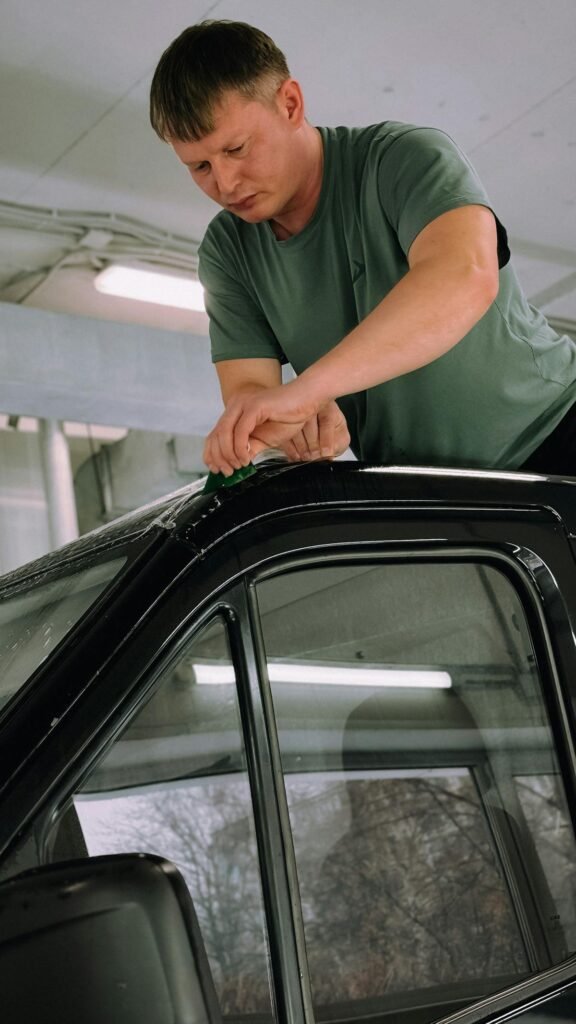
Our instructor Alex has tinted cars professionally since 2012 and has worked on more than 15,000 of them. Here’s how the mobile model works: setup, pricing, scheduling, and when it makes sense to move up.
Why Mobile Beats a Shop When You’re Starting Out
Put the two side by side and the argument settles quickly.
A suburban shopfront means paying rent every month before you’ve touched a single car. Add a fit-out, with proper lighting, signage and a clean, enclosed bay, and you’re spending serious money upfront. Then there’s the lease. A commercial lease commits you to a set term, which is a big bet on a business you’re still learning.
A mobile setup has none of that. Your startup costs are tools, film stock and insurance, plus a vehicle you may already own. You’re not paying rent on a quiet Tuesday when nobody books in.
The other thing people don’t think about: a shop means customers have to bring the car to you, arrange a lift and pick it up later. Mobile means you go to them while they’re at home or at work. That convenience matters to people.
For the wider picture of getting into this trade, including business registration, insurance and finding customers, read our guide on how to start a window tinting business in Australia.
Setting Up Your Mobile Rig
Vehicle Choice
A van such as a Toyota HiAce or Hyundai Staria gives you a clean, weatherproof cargo area, enough length to store film rolls flat, and a professional look when you pull up at someone’s home. A ute with a canopy also works: a little less interior space, but often cheaper to buy and run.
Trailers are the budget option. They’re cheap to kit out, but they look less professional and can be a pain in tight suburban streets. We’d only start with a trailer if you need to test the business before spending more.
Plenty of mobile operators, especially when they’re starting out, just use their own car. Store your gear in a spare room or garage, load it up the night before and go. It’s not glamorous, but it works until the jobs justify an upgrade.
What Goes in the Van
The gear list for mobile tinting is compact. You need:
- Film rolls: stored flat or upright, protected from heat and moisture
- Squeegees: a rubber squeegee for the inside of the glass and smaller windows, a larger one for big windows, and contour squeegees for tight spots such as quarter windows
- Hard cards: for locking the film in place and heat shrinking
- Stainless steel tinting knife and fresh blades: ordinary carbon steel snap-off blades can scratch glass
- Heat gun: for shrinking film to fit curved rear windows
- Spray bottles: slip solution (water with a little baby shampoo) and clean water
- Scrapers and blades: for prep and cleaning glass
- Lint-free cloths: always
- Portable lighting: so you can check properly for contamination and bubbles
All of that fits in a van or the back of a ute with a canopy. Our guide to window tinting tools and equipment goes through each item. Film is the main stock cost: in October 2026, one Australian online retailer listed 1.52 m × 30 m rolls of its carbon film at about $250. For insurance, insurance broker Upcover’s August 2026 data puts typical annual public liability premiums for small businesses at around $370 to $840, with automotive businesses at around $1,497.
One optional upgrade worth knowing about is a digital film plotter, which cuts film patterns to suit each car model. It’s a bigger investment and overkill when you’re starting, but once you’re doing steady volume, it can save time and film.
Where Do You Actually Do the Work?
It’s a common question from people who haven’t seen mobile tinting in action: “Where do you tint the car, in the street?”
No. This is the key to how the mobile model works properly: the customer provides the workspace.
Dust and wind are the enemies of window tinting. Dust trapped under the film shows as a mark that won’t go away once the film is on, and that means a callback to redo it. So the standard practice for a mobile tinter is to ask for a garage, carport or covered area, as enclosed as possible, with no wind and no airborne dust settling on the glass mid-install.
When you quote a job, make this clear upfront. Many customers have a garage or carport and it’s no issue. Some don’t. In that case, you either pass on the job or agree on a very clean, sheltered spot. Don’t compromise just to get the booking. One bad result from a dusty open-air install costs you more in callbacks and reputation than passing on a tricky job.
The practical upside of this model is that you don’t need to provide or lease a workspace at all. The customer’s garage is your installation bay. That’s a legitimate business model, not a workaround. Our step-by-step guide on how to tint car windows shows what happens once you’re set up in the bay.
Pricing for Mobile Work
Public sources give a picture of what Australians pay. Airtasker’s cost guide (checked 12 October 2026) reports a median of $200 for car window tinting jobs on its platform, with a typical range of $130 to $331. Tint shops price higher: in October 2026, 11 shops in five states listed the side and rear windows of a hatch or sedan at $240 to $450 in carbon film and $285 to $650 in ceramic, with SUVs and large 4WDs costing more. Jobs booked through Airtasker sit towards the lower end of that picture. Our guide to window tinting costs in Australia has more on current prices.
Film is a small part of a job’s cost. US supplier Flexfilm estimates that a roll the size of the one above does around 12 vehicles. For a mobile tinter, the cost that grows fastest is travel.
Worked example (assumptions, not a forecast):
- The ATO’s cents-per-kilometre rate for 2026–27 is 91 cents per kilometre. It’s the rate a sole trader can use to claim a car’s running costs, and it takes in fuel, registration, insurance, servicing and depreciation, so it’s a fair guide to what driving really costs (the ATO method itself only applies to a car, up to 5,000 business kilometres each year).
- A customer 50 km from your base means a 100 km round trip: about $91 of vehicle cost.
- A customer 10 km away means a 20 km round trip: about $18.
- The job is priced at $200, the Airtasker median.
On those assumptions, the far job spends about 45% of its price on the drive before you’ve counted film, your time behind the wheel or anything else, while the near job spends about 9%.
Results vary: these are assumptions, not outcomes.
Shops in our cost guide handle travel in different ways: one Adelaide shop’s tint booking form adds $100 for mobile service, one Melbourne mobile tinter may charge $50 to $100 extra for suburbs more than an hour from its base, and one Perth mobile tinter includes metro travel in its prices.
The lesson is: don’t race to the bottom on price, and price your travel. A cheap job a long way away can cost you money. Charge fair prices and deliver quality work: that’s how repeat customers and referrals can build.
If you’re thinking of running mobile part-time before going full-time, read Window Tinting as a Side Hustle: A Realistic Guide, which covers running a mobile setup on weekends around a day job.
Booking and Scheduling: Keep It Simple
When you’re starting out, you don’t need booking software, a CRM system or an expensive website. Phone calls and Facebook Messenger are enough to take bookings when you’re starting out.
Set up a Facebook Business Page. Post before-and-after photos consistently: real cars, real results. Respond quickly to messages. Word of mouth in local community Facebook groups moves fast, especially for trades.
Set up your Google Business Profile, which is free. Fill it out properly with your service area, hours and photos, and ask every customer to leave an honest review. If you don’t serve customers at your own address, Google lets you list as a service-area business: you hide your address and enter the suburbs or postcodes you cover instead. It’s a useful free step towards being found by people searching for car tinting in your suburb.
For scheduling, a basic Google Calendar or even a paper diary works fine until your diary gets busy. At that point, an online booking tool or a simple CRM starts to save you time. But don’t overthink it in the early months. The priority is doing great work, not building an admin system.
Managing Your Service Area
Pick a service radius you’re happy to drive, then publish it. Even a modest radius from home covers a lot of suburbs and households in any metro area, and Google Business Profile lets you list up to 20 service areas.
The discipline to build early: don’t drive an hour each way for a low-priced job. As the worked example shows, travel eats into a job fast. Set your service area clearly on your Facebook Page and Google Business Profile, and be upfront with customers outside it. If they really want you, they’ll pay a travel fee.
When you have several bookings in a week, batch them by area: one day in the northern suburbs, another in the east. You’re not criss-crossing the city burning time and fuel. It takes a bit of planning, but it becomes second nature quickly.
Some operators also set themselves up as the tinter for a particular area and own it. “The mobile tinter in [suburb or district]”: become the known operator in your patch, so referrals have somewhere to point.
Growing from Mobile to a Shop: When It Actually Makes Sense
A lot of people assume mobile is just a stepping stone and the goal is always a shop. That’s not automatically true. Some operators stay mobile for years, with flexible hours and low overheads. That’s a legitimate end state, not a failure to grow.
That said, there are clear signals that a shopfront starts to make sense:
- You’re consistently booked out and turning down work
- You want to hire another tinter, which is hard to manage from a van
- You want to take on commercial work (buildings, offices) that a mobile setup can’t service well
- You’re getting regular work from car dealers who want reliable throughput
A shop gives you control over the environment, which matters for quality, lets you do more volume and builds a business that can grow beyond you. But it also locks you into rent and fixed costs. Make the move when your existing revenue comfortably covers the rent, not before.
Getting the Skills Right First
None of this works if the tinting itself isn’t good. Mobile work amplifies both good and bad results: customers talk to their neighbours, post in local Facebook groups and leave Google reviews. A great job brings referrals. A bad one can end up as a photo in a community group.
Tinting skills come from private trainers, online courses or learning on the job in a shop. When we checked TAFE NSW and training.gov.au in October 2026, car tinting appeared as an elective unit inside broader automotive qualifications rather than as a course of its own; our guide to TAFE window tinting courses has the details.
The Window Tint Training Institute’s online course costs $129.95 AUD, with lifetime access. Alex takes you through the tools, slip solution and choosing film, then every window of a car, step by step, using both top-loading and bottom-loading methods. You work through it at your own pace and can rewatch any lesson when you need it, which is handy when you hit a tricky rear windscreen for the first time and want to review the technique before you start. You can see the full lesson list before you buy.
The mobile model is a low-capital way into the trade: modest startup costs, flexible hours and a service area that can span a whole metro. You don’t need a shop to start. You need skills, a basic kit and the discipline to show up and do quality work every time.
Start lean, build your reputation, and let your bookings tell you when it’s time to grow.
Want to learn to tint properly?
Our online course is $129.95 AUD, with lifetime access and a certificate after a video assessment. Every window of a car, step by step, taught by our instructor Alex.
Enrol now – $129.95 AUDOne payment · Lifetime access · 7-day refund