Window Tinting as a Side Hustle: A Realistic Guide
If you want a side hustle where you work with your hands on weekends, the usual suggestions each have a catch. Dropshipping means managing suppliers and stock. Rideshare means trading your time for kilometres. Lawn mowing is hard to charge enough for to make it worth your Saturday. Window tinting keeps coming up as an answer, and this guide explains why it works for some people and what it takes.
Our instructor Alex has tinted cars professionally since 2012 and trained more than 230 students in person before filming our online course. This guide draws on what he teaches.
Why Window Tinting Actually Works as a Side Hustle
Most side hustles have a hidden catch. Reselling means managing stock and chasing suppliers. Food delivery puts the kilometres on your car. Tutoring means turning up at set times whether it suits you or not.
Window tinting avoids most of those problems.
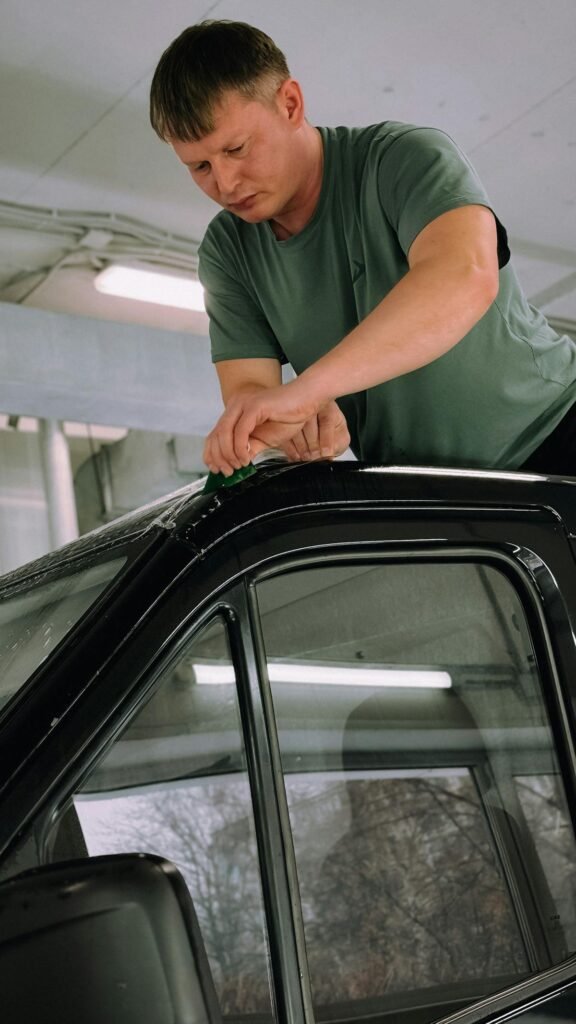
There’s no shopfront to pay rent on and no inventory piling up in your spare room. You carry a roll or two of film, a small tool kit and your skills. The customer either comes to you, if you work from your garage, or you go to them. Either way, you choose which bookings to take.
The material cost of each job is small next to the price. Film is bought by the roll: in October 2026, one Australian online retailer listed a 1.52 m × 30 m roll of carbon film at about $250, and US supplier Flexfilm estimates that a roll that size does around 12 vehicles. Customers pay far more than that for the finished job. When we checked Airtasker’s cost guide on 12 October 2026, it put the median car tinting job on its platform at $200, and in October 2026 the tint shops in our cost guide listed carbon film on a hatch or sedan at $240 to $450. The worked example below shows the arithmetic.
The Weekend Maths: Run the Numbers Properly
A lot of side hustle content oversells the earning potential, so here’s what we will and won’t do. We won’t put an annual figure on it, because that depends on bookings nobody can promise. We will show you the arithmetic on one job, with every assumption stated, so you can put in your own numbers.
Worked example (assumptions, not a forecast):
- One sedan on a Saturday, done in carbon film for $300, inside the $240 to $450 that shops listed for carbon.
- Film: about $250 for a roll that does about 12 cars, so roughly $21 for this car.
- Slip solution, blades and wastage: say $20, a round figure we’ve assumed rather than a sourced price.
On those assumptions, the job leaves about $259 before travel, insurance, tools, advertising and tax.
Results vary: these are assumptions, not outcomes.
In your first months, expect fewer bookings and slower jobs while you build your technique and your confidence. That’s normal. The going rate in your area may also be lower or higher than the example, so check local prices before you set yours. Our guide to window tinting costs in Australia has more on what customers pay.
Tax and GST on Side Income
Your tinting income doesn’t sit apart from your job. As a sole trader, your business income is taxed as part of your own personal income, so it’s added to your wage and taxed at the individual rates. Put part of every payment aside for tax. You must register for GST within 21 days of your GST turnover reaching $75,000 or more, and the ATO counts expected turnover as well as past turnover. Below the threshold, registering is optional. You’ll need an ABN, and it’s free to register for one through the Australian Business Register at abr.gov.au.
How Long Does Each Job Actually Take?
People often assume a tint job takes all day. Shops quote less than that: one Sydney shop says a smaller car usually takes about 1 to 3 hours, a Melbourne detailer says 2 to 4 hours, and an Adelaide shop says most standard cars take 3 to 4 hours. A beginner will be slower than a shop, and a bigger vehicle with more glass takes longer than a small hatch.
That means one car doesn’t have to take your whole weekend. Two in a day may become possible once you’re quicker, but don’t push it early. Rushing your second job of the day is how you end up with callbacks and unhappy customers.
As a side hustler, one car a day is a sustainable, comfortable pace that still leaves time for the rest of your weekend.
Your Garage Is Your Workshop
You don’t need a van fitted out with lighting and shelving, and you don’t need to rent a commercial space. If you have a single-car garage, you have a workspace.
The one thing you can’t compromise on is an enclosed space. Dust and wind are the enemies of a good tint job: dust trapped under the film shows as a mark that won’t go away once the film is on. An enclosed garage, yours or the customer’s, solves that. A windy driveway is a poor substitute.
Your essential kit looks something like this:
- Squeegees: a rubber one for the inside of the glass, a larger one for big windows and contour squeegees for tight spots
- A stainless steel tinting knife and blades
- Heat gun
- Spray bottles for slip solution and clean water
- Hard cards for locking the film in place and heat shrinking
- Lint-free cloths
- Film stock in two or three shades that are legal where you work
Check the legal limits before you buy film. Every Australian state and territory sets a minimum visible light transmission for car windows, and our guide to window tint laws in Australia sets them out state by state. Our guide to window tinting tools and equipment goes through each item in the kit.
Compare that kit to buying into a franchise, setting up a mobile food business or anything in construction, and it’s a low bar to clear. For everything else you need to get a tinting business off the ground, not just the tools, read our full guide on how to start a window tinting business in Australia.
Finding Your First Customers
This is the part many new side hustlers overthink. You don’t need a website on day one, and you don’t need to run paid ads. Here’s where to start:
Don’t list your tinting on Facebook Marketplace: Meta’s Commerce Policies don’t allow services to be sold there. Set up a Facebook Page for the business instead, with a few photos of your work, your area and how to book. Reply quickly and professionally to every message, and you’ll turn more enquiries into bookings.
Local Facebook Groups
Car enthusiast groups and local suburb and community groups all have members who want their cars tinted. Post once, mention you’re local and include your contact details. Don’t spam, but a single post in a few groups can bring in enquiries.
Gumtree
Still useful, particularly for reaching people who aren’t on Facebook. Same principle: a clear listing, honest prices and photos if you have them.
Friends, Family, Word of Mouth
Your first few jobs will probably come from people you know. Tell people what you’re doing. A mates rate on your first few cars can get you practice and photos for your portfolio. Ask every paying customer for an honest Google review, but don’t offer a discount for one or ask family to post one: Google’s policies prohibit incentives for reviews and reviews from family members.
Google Business Profile
A Business Profile on Google is free, and it helps you show up in local searches. If you work at customers’ homes, you can list as a service-area business without showing your address. It builds over time as reviews come in, so set it up early.
Training: The $129.95 Question
Here’s the honest version of this conversation.
The Window Tint Training Institute’s online course costs $129.95 AUD as a single payment, with lifetime access, and you watch at your own pace. Our instructor Alex takes you through every window of a car, step by step: the tools, cleaning the glass, cutting a pattern, heat shrinking, and door, rear and quarter windows. You can see the full lesson list before you buy, and our free guide on how to tint car windows walks through the process with eight of the lessons. That’s a reasonable investment before you start working on a stranger’s car.
But training doesn’t make you perfect on your first job. Your first car won’t be flawless. Maybe the rear windscreen has a small crease you couldn’t fully work out, or a side window has a tiny air bubble in one corner. That’s not a failure. That’s the reality of learning a physical skill. What training does is teach you the correct technique from the start, so you’re not building bad habits you’ll spend months unlearning, and give you the confidence to charge for your work rather than doing it free “for practice” indefinitely.
Before filming the course, Alex ran five-day hands-on workshops, and the online lessons follow the same order he taught there.
When Does a Side Hustle Become a Full-Time Business?
You don’t have to decide up front. That’s one of the advantages of starting a trade skill as a side hustle: you can let your bookings tell you when the time is right.
These are the signs we’d look for before you consider going full-time:
- You’re consistently booked two or more weeks ahead, not just occasionally
- You’re turning down weekday enquiries because you’re at your day job
- What you clear per hour from tinting, after costs, is more than you earn per hour in your main job
- You’ve been doing it for at least three to four months and the demand hasn’t dried up
When all four are true at the same time, the decision gets much clearer. Read our article on how much window tinters make in Australia for employed pay, customer prices and costs before you make any decision about leaving your day job.
The Bottom Line
Window tinting is a legitimate side hustle for someone who’s willing to learn a skill and put in a couple of weekends a month. The startup cost is low, the tools are manageable, and the material cost on each job is small next to the price.
Start with one car on a weekend. Do it well, photograph it and ask for a review. That’s not a get-rich scheme. It’s a tradeable skill, applied sensibly, on your own schedule, and it starts with your first car.
Want to learn to tint properly?
Our online course is $129.95 AUD, with lifetime access and a certificate after a video assessment. Every window of a car, step by step, taught by our instructor Alex.
Enrol now – $129.95 AUDOne payment · Lifetime access · 7-day refund